
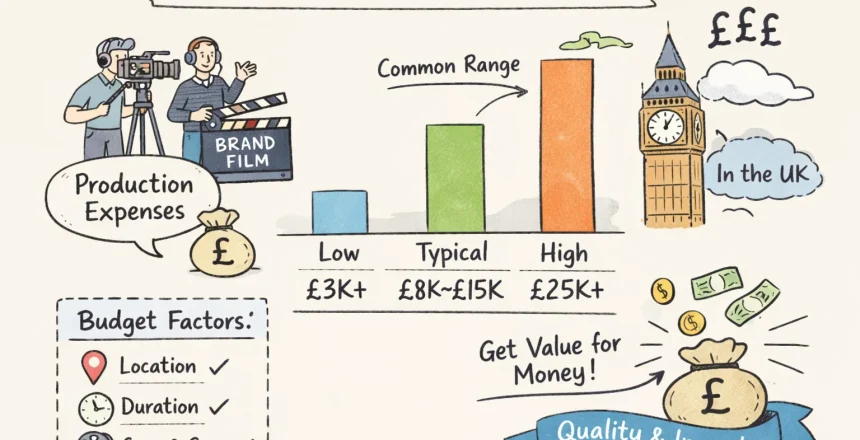
The typical cost range for a short brand film is a very moveable feast; A 30-second low-end film typically fits the single-operator bracket, while a 30–90 second mid-range film supports stronger storytelling and distribution-ready assets that tend to perform better. Requiring broadcast delivery, custom music or extensive motion graphics pushes a project into the £10,000+ range because you pay for polish, original elements and compliance. Choose the tier that matches your audience and distribution channels so your budget delivers the outcomes you need.
What you need to know
These bands reflect typical deliverables, crew sizes and turnaround expectations.
Quick answer: typical price ranges and what they buy
Here’s the short answer: budgets range from a few hundred pounds up to mid five figures depending on scope and finish. Below are practical tiers and what each typically buys so you can match budget to objectives.
Low budget (£500–£3,500) typically covers a one-day, single-operator shoot, minimal pre-production, a basic edit, a stock music licence and one or two social cuts. Turnaround tends to be fast and deliverables lean, with limited coverage, creative camera setups and revision time. This tier works for quick social formats, simple product promos or organisations testing a message.
Mid-range (£3,000–£10,000) buys concept and script time, one to two shoot days with a small crew (director, DOP, sound), better kit, basic motion graphics and a colour grade with multiple deliverables. The higher production value supports stronger storytelling, wider distribution and reuse across paid and owned channels. Choose this tier when you need a reliable, reusable asset set for a campaign.
High-end (£10,000+) covers multi-day shoots, cast, original music or high-end sync licences, agency-level post-production, bespoke motion graphics and broadcast legalities. Budgets increase further with complex locations, stunts, multiple units or strict compliance requirements. Use this level when the film needs to run on TV, large-scale digital buys or high-profile placements.
How a short brand film budget breaks down
Think of a quote as three buckets: pre-production, production and post-production. As a rule of thumb, plan roughly 10–20% of the budget for pre-production, 50–70% for production and 20–30% for post-production; these proportions shift toward production and post as complexity increases.
Pre-production covers concept, scripting and logistics, and spending efficiently here often saves money later. Typical ballpark costs include concept development £500–£2,500, scriptwriting £500–£1,500 and location scouting, permits and scheduling £200–£1,000.
Production is the largest line item and includes day rates and kit hire. Typical day-rate examples are director £800–£2,500, director of photography £400–£800 and kit £500–£2,000; additional crew generally charge £350–£600 per day, and multi-day shoots add travel, catering and location fees.
Post-production includes editing, colour grading and motion graphics, with editors typically charging £400–£600 per day and grading around £500–£1,500 per project. Motion graphics range from about £500 to £4,000 depending on complexity, and revision allowances, final formats and the number of deliverables all influence the final price. For up-to-date corporate benchmarks you can review a detailed corporate video pricing guide for 2026.
Major cost drivers
The headline price ranges hide recurring add-ons that push quotes up, so knowing the common multipliers helps you budget better. Producers start with base day rates, then add items such as talent, music and permits that can move the needle quickly.
Talent and casting often surprise clients because fees and usage rights vary widely. Casting directors, spokespeople and recognisable faces typically add about 10–20% to a quote, and broadcast usage increases fees further.
Music, voiceover and licensing are other easy-to-underestimate costs. Voiceover rates typically range £500–£2,000 while licensed tracks can move from around £500 to £5,000 or more; custom composition adds further cost and control. If you need a quick reference on professional voiceover fees, see this guide to professional voiceover artist cost.
Locations, permits, insurance and logistics are frequent drivers. Small location hire is commonly £200–£800 per day while premium sites cost more, and CAA-licensed aerial work requires specialist fees and additional insurance.
Freelancer vs agency: where to cut and where to invest
Choose the model that matches project risk and scope. Freelancers work well for single-location, fast-turnaround social shoots because day rates and overhead are lower, while agencies fit campaigns that require integrated strategy, compliance and multi-format delivery.
Agencies cost more because they manage casting, permits, creative oversight and delivery across formats, which reduces the risk of re-shoots and long revision cycles. For campaigns that must run across TV, social and web, that control often saves money over the medium term.
Radar Film’s transparent tiers map budget to outcomes: Social Starter £500–£2,500 (single operator, one edit), Story £3,000–£6,000 (scripting, half-day shoot, basic motion graphics) and Hero £10,000+ (full crew, multiple locations, grading and multi-format delivery). We also offer hybrid packages that pair trusted freelancer crews with agency-level project management to balance cost and control. Invest where it preserves the creative idea and avoids cutting into what makes the film work.
Save money without losing impact
Planning is the clearest lever to reduce cost without sacrificing production value. Smart creative choices can shift budget away from extra shoot days and heavy post while keeping audience impact.
Design multi-use shots, favour practical locations and hire experienced operators who need less coverage. A focused shot list and tight schedule reduce retakes and editor hours, and efficient set-up and strike save real time on shoot days.
Plan deliverables at briefing so one shoot yields hero, social and paid cutdowns, and use templates for aspect ratios and lower-thirds to avoid repackaging costs. Negotiate sync licences to limit territory and duration, or commission bespoke compositions when that proves cheaper over time. If you’re a small business trying to stretch a modest budget, our Small Business Brand video: 7 Tips for Budgeting Wisely article offers practical, low-cost strategies.
How to brief and get accurate quotes
A clear brief removes guesswork and makes quotes comparable. Specify running time and target platforms, mandatory messages and examples you like, shoot windows and preferred locations, plus exact deliverables and usage rights (territory, duration, formats) so producers can price with certainty.
Ask every producer these ten questions to normalise quotes and create a fair comparison. Use the answers to compare line items rather than totals.
- How many shoot days?
- Who is in the crew and what are their day rates?
- What kit is included?
- How many edits and revisions are included?
- Who owns the raw files?
- What licences are included?
- What are payment terms?
- What’s the turnaround?
- Are travel and expenses included?
- What’s the cancellation policy?
For a concise checklist and practical pointers on estimating costs, see our four tips on costing your business video, which helps translate creative aims into line items producers can price against.
Summary and next steps
If you asked what is the typical cost range for a short brand film in the UK, budgets run from low thousands for punchy social pieces to mid five figures for broadcast-ready spots, depending on scope and deliverables. View every quote in terms of pre-production, production and post-production to compare like for like.
Crew size, on-camera talent, locations and post-production depth determine whether a film feels simple or cinematic, and rights and licences are common cost multipliers. With a clear brief and the right production model you can match spend to impact and measure results against campaign goals. For broader market benchmarks on video production prices and how different services are commonly charged, that resource is a useful comparison point.
Finally, if you want sector context on how production investment is scaling nationally, the BFI’s 2025 production statistics give a helpful view of industry spend and trends.
Next step: draft a one-paragraph brief listing runtime, target audience and three must-have moments, then send it to Radar Film for a quick ballpark estimate. A focused brief turns uncertainty into a practical budget conversation you can act on this week.